
Solving the Teacher Shortage: A Small Texas District Changed My Mind About the Future of Schools

A District Once in Crisis
The last time I visited Shepherd ISD, near my hometown in East Texas, the mood was heavy. The district was about to be placed under state conservatorship — the most serious level of state intervention — and what I saw reflected that reality: chaotic classrooms and apathetic educators. A sense of resignation hung in the air. It was the kind of environment that makes you worry about the future of public education, not just in one small Texas town, but everywhere. When I returned this fall, I didn’t know what to expect. What I encountered was one of the most inspiring, forward-thinking approaches to solving the teacher shortage — and reimagining student learning — that I have ever seen.
Shepherd ISD’s journey from that moment to now is nothing short of remarkable. Like many districts across the country, they faced the dual challenge of a chronic teacher shortage and the urgent need to improve student outcomes. But unlike most, they refused to accept those challenges as insurmountable. Instead, the district’s leadership team — including Superintendent Jason Hewitt, Director of Teaching and Learning Tammie Hewitt, Regional Assistant Superintendent of Talent Kriste Davis, and Coordinator of Instructional Technology Chip Seagroves — set out to fundamentally rethink what teaching and learning could look like in a small, rural district.
In the past year, my company, friEdTech, has had the privilege of partnering with Shepherd ISD to support that vision — from helping develop AI policy and delivering professional learning for teachers, to facilitating leadership learning experiences and delivering keynote sessions for the entire staff. Our work together has given me a front-row seat to a transformation that doesn’t just patch holes in a struggling system — it reimagines what public education can be.
The APEX Solution: Excellence Without Compromise
The first innovation, and the one that brought me to the district today, was Shepherd ISD’s APEX program — a collaborative teaching model built on the belief that every student can have access to an exceptional educator, regardless of staffing shortages. In many districts, a vacant teaching position leads to a revolving door of substitutes, inconsistent instruction, and inevitable learning gaps. APEX solves that problem with ingredients every district has access to.
In this model, a single master teacher simultaneously instructs roughly 100 students across four classrooms, supported by co-teachers and instructional aides. Through a carefully choreographed blend of technology — including Google Meet, Smart’s Lumio platform, Pear Deck, Kami, and WayGround — students in each room see and hear the same high-quality lesson in real time. They can interact directly with the teacher, respond to questions, and even be randomly called on, no matter which room they’re in. Meanwhile, adults in each classroom provide on-the-ground support, manage behavior, and offer individual attention, creating a seamless blend of expert instruction and human connection.
NSpire: Growing Great Teachers From Within
The second innovation I witnessed was equally powerful but addressed a different — and often overlooked — part of the teacher shortage problem: the pipeline. Shepherd ISD’s NSpire program is a “grow your own” initiative that identifies talented, committed individuals already working within the district — often as paraprofessionals or long-term substitutes — and supports them in becoming fully certified classroom teachers.
These educators-in-training participate in a teacher residency program, serving as full-time teachers while the district covers the cost of their four-year university degree. In return, they commit to teaching in Shepherd ISD for the duration of their program and for at least three additional years after they complete it. The results are astonishing: it wasn’t just difficult to tell who was a veteran educator and who was still in training — it was impossible. My guides even asked me to guess which teachers were in the program and which were already certified. I was wrong more than half the time. That’s how seamless the quality of instruction has become under this model.
Impact in the Classroom: Excellence at Every Level
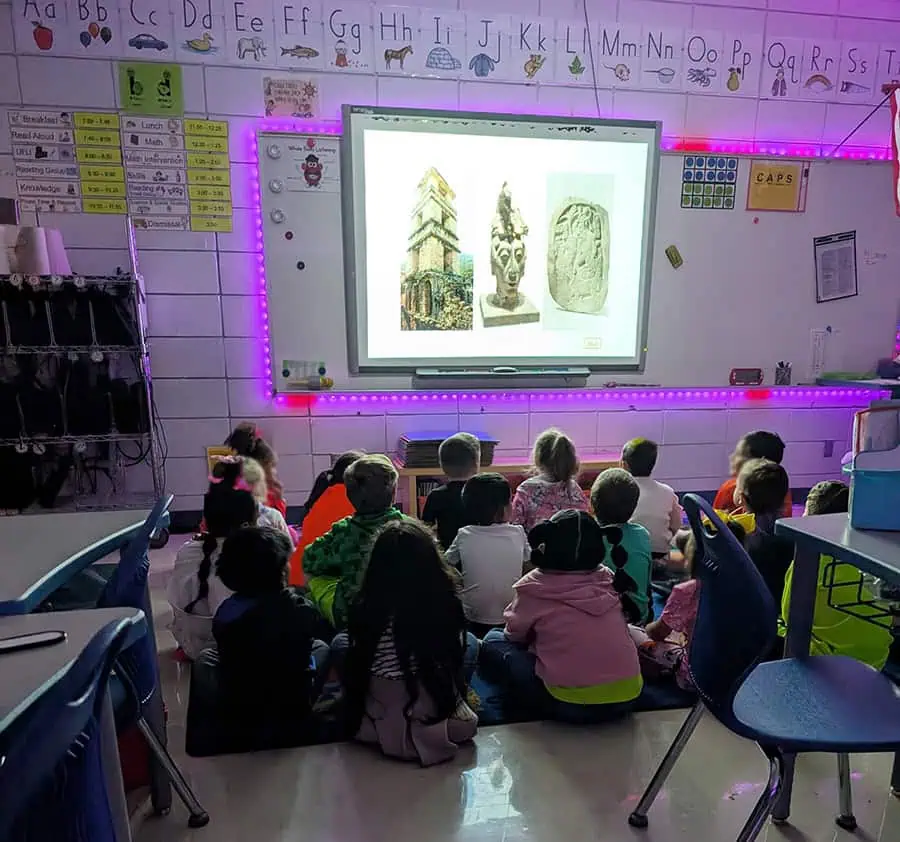
What struck me most was how these two programs — APEX and NSpire — are working in tandem to completely transform the student experience. In the fourth- and first-grade classrooms I observed, students were deeply engaged in solid, foundational, and consistent instruction. Every lesson I saw was well-paced, clearly structured, and aligned to rigorous learning goals — whether it was being delivered by a master teacher projected across three classrooms or by a teacher-in-training leading their own room. Students weren’t passive recipients of information; they were participating, responding, and mastering essential skills. And perhaps most importantly, every student had access to expert instruction and a caring adult presence every single day, even in a district that once struggled to staff its classrooms.
Results That Speak for Themselves
The impact of these programs is visible and measurable. Since launching APEX and NSPIRE, Shepherd ISD has seen significant improvements in both student outcomes and staffing stability though staffing remains a persistent challenge. Through innovative funding models and creative use of grant dollars, the district has been able to offer compensation packages that far exceed the state average, with some high-performing teachers now earning more than $100,000 per year.
Perhaps the most striking example of this transformation is at the intermediate campus, which had endured a decade of failing performance before APEX. Today, that same campus is on an upward trajectory: 81% of students in APEX classrooms met or exceeded their growth targets on the STAAR test. NSPIRE is proving equally effective — about 80% of the first cohort have either completed the program or are still pursuing certification, and 90% of graduates have remained in the district beyond their three-year commitment. These results show that while challenges persist, Shepherd ISD has built powerful, scalable solutions to overcome them.
A Model Every District Can Learn From
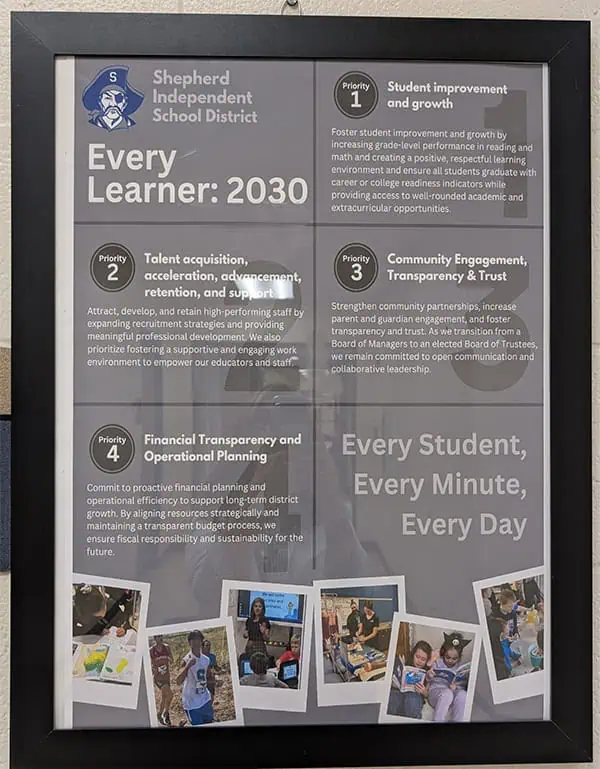
Shepherd ISD’s story is more than a local success — it’s a blueprint for what’s possible in public education everywhere. Teacher shortages aren’t going away anytime soon, and the traditional strategies districts have relied on simply aren’t enough. What Shepherd demonstrates so clearly is that solutions do exist, and they don’t require massive budgets or urban resources. They require courage, creativity, and a willingness to rethink long-held assumptions about how schools operate.
Every district has untapped talent among its paraprofessionals and support staff — NSpire shows how to cultivate that talent into a sustainable teacher pipeline. Every district has a handful of exceptional teachers — APEX shows how to extend their reach far beyond a single classroom. And every district can leverage technology as a powerful tool to ensure consistent, high-quality instruction for all students.
The urgency could not be clearer: about 1 in 8 teaching positions nationwide are either unfilled or staffed by teachers who are not fully certified, a number that continues to grow as enrollment in teacher preparation programs declines (Learning Policy Institute, 2025).
For districts ready to explore what this approach could look like in their own communities, Shepherd ISD is opening its doors. To learn more or arrange a visit, contact Tammie Hewitt, Director of Teaching and Learning @thewitt@shepherisd.net, who can provide details about upcoming observation opportunities.
Closing Reflection: Hope for a Stronger Future
We are at a critical juncture in public education. The stakes are too high to continue doing things the way we’ve always done them. Shepherd ISD’s approach offers a profoundly practical and hopeful path forward.
What I witnessed in those classrooms reminded me that with the right structure, a clear vision, and caring people, a district can defy odds, overcome chronic challenges, and deliver on the promise of excellent schooling for every child. Shepherd’s journey shows that we don’t have to wait for perfect conditions or massive budgets to act. The intelligence, heart, and ingenuity of educators can make a big difference, fast.
This work isn’t happening in isolation. Through our ongoing partnership, the team at friEdTech will continue to support Shepherd ISD this year as they deepen their work with AI integration, build educator capacity, and refine their vision for the future.
If any district wants to see this in action — to walk the halls, sit in the classrooms, talk with the teachers, and witness APEX and NSpire in motion — Shepherd ISD stands ready to welcome you. What they’ve built may very well be an important roadmap for the future of schooling.

What Clients are Saying...

